





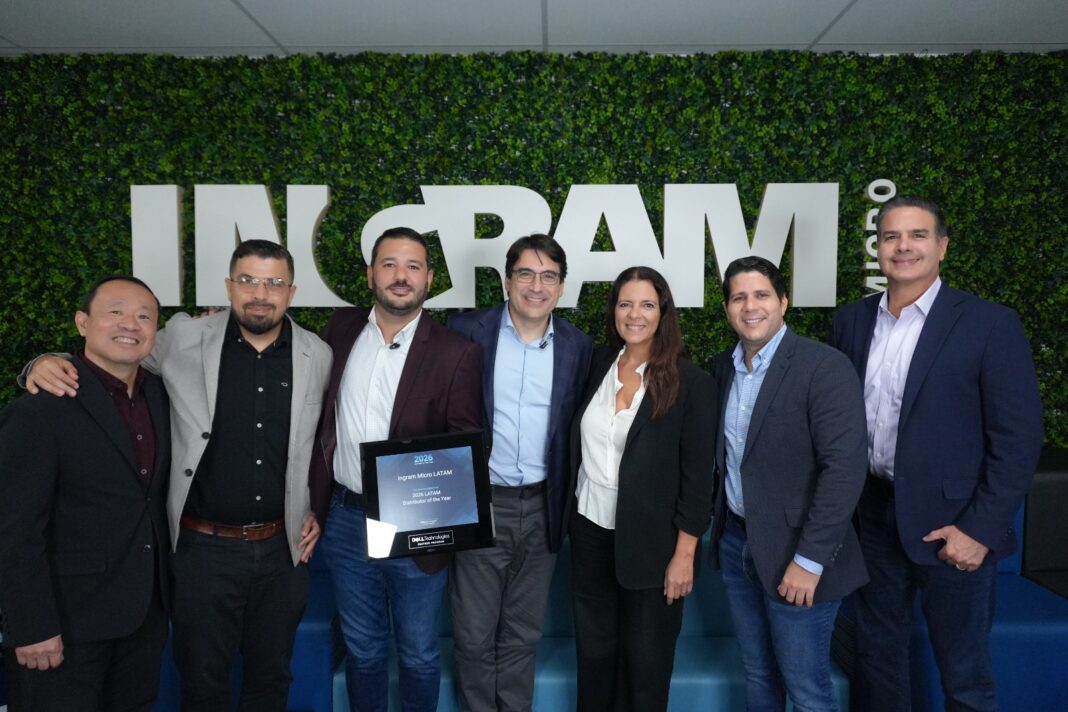





Ingram Micro has built a strong presence across Latin America, standing out for the evolution of its technology distribution business and its ability to adapt to the industry’s constant changes. We spoke with Diego Moure, Regional Business Manager for Dell Technologies at Ingram Micro, to learn what the company is doing differently and what lies ahead.
Ingram Micro has been a key player in the region for the past nine years. What has changed during that time, and what remains at the core of the company’s value proposition?
A great deal has changed. Nine years ago, the conversation was primarily focused on product availability, logistics, and transactional execution. Today, we are talking about artificial intelligence, digital platforms, automation, services, and new ways to help our business partners grow.
Ingram Micro has also evolved. We have become a platform company, integrating digital capabilities and tools such as Xvantage, which allow us to simplify operations and create new opportunities for our business partners.
What has remained unchanged is the core of our value proposition: our close relationship with the channel, our execution capabilities, and our commitment to helping customers and partners grow. Technology evolves, but trust and execution remain essential.
Artificial intelligence has been one of the industry’s main topics this year. For a distributor like Ingram Micro, does AI represent an immediate opportunity in the region, or is the market still in a preparation phase?
I believe it’s both at the same time. We are already seeing concrete opportunities around AI PCs, infrastructure modernization, and AI-driven projects within organizations looking to improve productivity, automation, and decision-making.
At the same time, much of the market is still in a preparation phase. Many organizations are defining their strategies, evaluating use cases, and understanding how to integrate AI responsibly into their operations.
This is why technology vendors and distributors like Ingram Micro have such an important role to play: helping organizations move from conversation to execution by ensuring they have the capabilities, infrastructure, and expertise needed to unlock AI’s real value.
Can you share an example that illustrates what a distributor, a manufacturer, and an end customer can achieve when collaboration works at its best?
Rather than highlighting a single case, what we consistently see is the impact created when each participant brings its strengths together. The manufacturer delivers technological innovation, the channel contributes customer knowledge and implementation capabilities, and Ingram Micro connects both worlds through financing, product availability, specialized support, logistics, and pre-sales expertise.
When these elements are properly aligned, the outcome is typically projects that enable organizations to modernize their infrastructure, improve workforce productivity, and accelerate their business objectives.
Central America includes markets with very different levels of technological maturity. How does Ingram Micro tailor its approach to make cutting-edge technology accessible to both large enterprises and smaller organizations?
That diversity is precisely one of Central America’s most interesting characteristics. There is no single strategy that works for every market.
Our approach combines a regional vision with local execution. We work closely with our business partners to understand the specific needs of each country, industry, and type of organization.
The breadth of our technology portfolio allows us to support customers at every stage of their digital maturity—from PC refreshes and productivity solutions to more advanced infrastructure, storage, and AI projects.
Our role is to make these technologies more accessible through training, financing, specialized support, and flexible models that allow organizations to adopt innovation at their own pace.
Organizations without an AI-first strategy risk falling behind. Does that message resonate with customers across the region, or is there still resistance or skepticism?
I believe the message is resonating more and more. A year ago, many conversations revolved around what AI actually was. Today, the discussion is much more focused on how to implement it and the impact it can have on business.
As with any major technological shift, there are still questions around investment, security, data governance, and expected return on investment. That’s completely natural.
However, what we are seeing is that interest is growing very rapidly, and organizations increasingly understand that AI is not a passing trend but a capability that will fundamentally transform the way we work and operate.
The question is no longer whether companies will adopt AI, but how quickly they will do so—and how prepared they will be to maximize its potential.
Looking ahead to the coming months, what do you see as Ingram Micro’s biggest challenge in Central America, and how are you addressing it?
I believe the biggest challenge is not technological—it is the speed of adoption. The opportunity around AI, infrastructure modernization, and technology refresh is enormous, but success will depend on how quickly we can help develop the capabilities needed to seize it.
That is why we are making significant investments in training, partner enablement, digital tools, and specialized support for our business partners.
At the same time, we continue working to provide product availability, financial flexibility, and execution capabilities across a region where economic and operational realities vary significantly from country to country.
Our goal is to enable customers and business partners to focus on innovation and growth while we help reduce the complexity associated with adopting new technologies.