










Barbados is utilising several methods, including improving data collection and working with international organisations, to receive guidance on best practices in its efforts to improve migration processes.
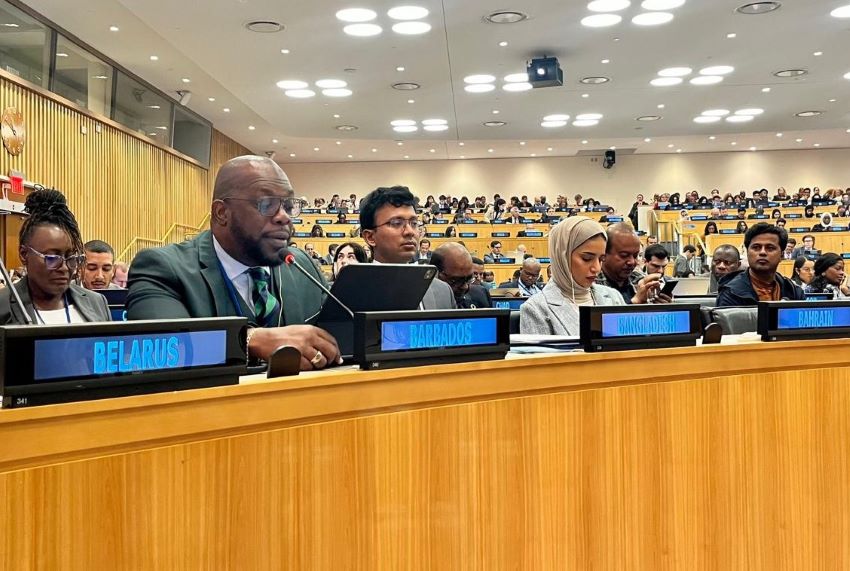
This was highlighted by Minister of Home Affairs and Information, Gregory Nicholls, as he intervened in Roundtable Four discussions today.
The Roundtable was one of four interactive multi-stakeholder sessions designed to review progress on the Global Compact for Safe, Orderly and Regular Migration (GCM), held during the United Nations (UN) Network on Migration Second International Migration Review Forum, at the United Nations Headquarters in New York.
Those GCM objectives are to collect and utilise accurate and disaggregated data as a basis for evidence-based policies; provide accurate and timely information at all stages of migration; address and reduce vulnerabilities in migration; eliminate all forms of discrimination and promote evidence-based public discourse to shape perceptions of migration; and strengthen international cooperation and global partnerships for safe, orderly, and regular migration.
Mr. Nicholls outlined Government’s position on the GCM objectives addressed in Roundtable Four. He noted that through collaboration with international organisations, the island has made progress in filling data gaps on migration.
“Barbados has engaged the International Organisation for Migration and the United Nations Department of Economic and Social Affairs to close persistent data gaps in small island developing states on irregular migration, migrant health and diaspora contributions. We have felt the impact of this policy, built on evidence and not sanctions, ensuring that no migrant is invisible,” he stated.
Speaking on the progress of GCM objective 7, which deals with addressing and reducing vulnerabilities in migration, Minister Nicholls shared that the Trafficking in Persons Prevention Act 2016 criminalises sex and labour trafficking, with penalties of up to 25 years’ imprisonment, while safe havens, restitution, and medical care are mandated by law.
He noted there is also a dedicated Sex Crimes and Trafficking Unit, which operates within The Barbados Police Service, and is guided by a National Action Plan built on prevention, protection, prosecution, and partnership.
In addition, he said the Caribbean Community Implementation Agency for Crime and Security and the Advanced Passenger Information System are deployed for pre-arrival screening at all borders, and climate-responsive frameworks are being advanced for small island developing states (SIDS).
“The impact [is that] vulnerable migrants, women, children, trafficking victims, and climate-displaced victims are all seen, protected and supported,” the Home Affairs Minister stated.
He also emphasised that although Barbados is a small island developing state, every objective pursued under the GCM cannot be viewed through a SIDS lens, because “one size does not fit all”.
Roundtable Four was co-chaired by Spain’s Minister of Inclusion, Social Security and Migration, Elma Delgado, and Bangladesh’s Minister of Expatriate Welfare and Overseas Employment, Ariful Choudhury.