





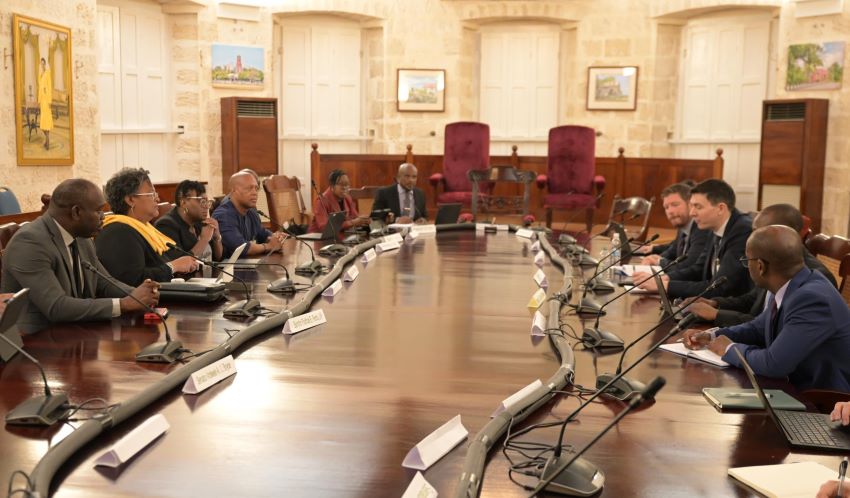






Prime Minister Mia Amor Mottley met earlier today with Barbados’ International Monetary Fund (IMF) Mission Chief, Michael Perks, and his team at the conclusion of a visit to Barbados from Tuesday, February 25, to Friday, February 28.
The team was on the island to analyse Barbados’ recent economic performance, in preparation for the fifth and final review of the Extended Fund Facility and Resilience and Sustainability Facility programmes.
Ms. Mottley, along with Minister in Finance, Ryan Straughn; Minister of Economic Affairs and Investment, Kay McConney; Governor of the Central Bank, Dr. Kevin Greenidge, and other senior officials, heard from Mr. Perks and his team that the island was making strong progress with its economic reform programme.
During the meeting at Parliament, the IMF Mission Chief noted: “Targets for the end of December 2024 under the Extended Fund Facility were met. Fiscal performance remains strong, with the primary balance reaching 5.3 per cent of GDP through December, leaving the authorities on track to meet the 3.8 per cent of GDP fiscal target for fiscal year 2024/25.”
Mr. Perks further stated: “Structural reform efforts continue to advance, supported by IMF technical assistance, including actions to strengthen customs administration, the framework for public-private partnerships, and the Central Bank of Barbados’ liquidity forecasting. The authorities are also making progress with the implementation of the RSF reform measures for the last review.”
Ms. Mottley gave an update on Government’s efforts to improve the social and economic outlook for the country that include the education reform agenda, the ageing population, and the need for senior citizens villages to decentralise the care of the elderly to the communities.
The Prime Minister also flagged the skills deficit in critical areas and the retraining of finance officers in the public service.
Meanwhile, Mr. Perks commended Ms. Mottley and her team for the positive economic outlook bolstered by tourism, construction, and business services.
He added that despite the positives, government needed to further strengthen “its contingency plans to create a buffer in the event of changes to the island’s economic situation”.