








Starting 21 Jan. 2026, some Caribbean nationals seeking to travel legally to the United States will face a significant new financial barrier.
The US government has added several Caribbean countries to an expanded list whose citizens may be required to post a bond of between $5,000 and $15,000 as a condition of receiving a B1 or B2 visa for business or tourism.
The US Department of State confirmed on 6 Jan. that the bond is mandatory and reimbursable but must be paid before a visa is issued and does not guarantee approval.
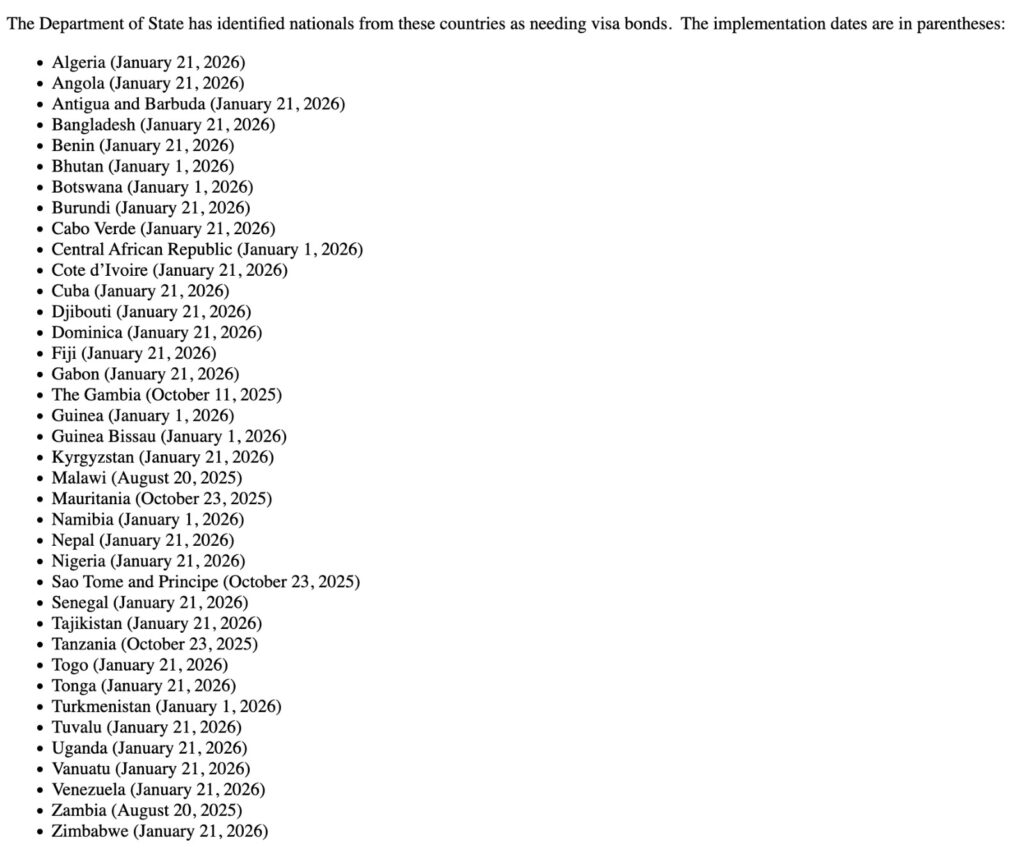
The policy applies to Antigua and Barbuda, Cuba, Dominica and Venezuela, alongside 34 other countries, as part of a broader tightening of US immigration controls under the Trump administration.
The original list of 13 countries announced in August 2025 has since been expanded by 25 more, bringing the total to 38. The full list, which includes four Caribbean nations, now also spans Bangladesh, Bhutan, Nepal, Kyrgyzstan, Tajikistan, Turkmenistan, Fiji, Tonga, Tuvalu, Vanuatu and 24 African countries.
The stated aim is to reduce illegal immigration and lower visitor overstay rates. An overstay refers to a nonimmigrant who was lawfully admitted for a specific period but remained beyond their authorised stay.
Citizenship by investment
According to a notice published in the Federal Register when the programme was introduced, the policy also targets countries where screening and vetting information is considered insufficient, as well as jurisdictions that operate citizenship by investment programmes.
As previously reported by the Compass, both Antigua and Barbuda and Dominica operate citizenship by investment schemes that allow individuals to acquire passports without residency requirements. London School of Economics has warned such programmes can create loopholes by allowing travellers from restricted countries to enter on secondary passports.
In Antigua, citizenship by investment is a key economic pillar, generating nearly 60% of government non-tax revenue in 2024. Russians made up about 6% of applications in the first half of 2023, before applications from Russian nationals were suspended following the outbreak of the Russia–Ukraine conflict. Between January and June 2024, Chinese nationals made up the majority of Antigua and Barbuda’s 739 citizenship by investment applications.
Overstay rates
US data show wide variation in overstay rates among affected countries. Antiguan nationals had an overstay rate of 1.3% in 2024, compared with 6.96% for Cuban nationals, 4.29% for Dominican nationals and 8.57% for Venezuelans.
Of the 20,486 overstays recorded from the four Caribbean countries in 2024, 93% involved Venezuelan nationals. Antigua and Dominica together accounted for 513 overstays for the entire year, while Cuba recorded 913.
Several other regional countries recorded much higher rates and larger numbers. Jamaica’s overstay rate was 3.43%, representing 10,560 people. Suriname posted a 31% overstay rate, or 4,116 people. Honduras recorded a 1.61% rate, or 5,016 individuals, while Guyana’s overstay rate was 4%, representing 2,926 people.
In fiscal year 2024, US Customs and Border Protection recorded 46.7 million nonimmigrant air and sea arrivals. The overall overstay rate was 1.15%, or 538,548 cases, meaning nearly 99% of visitors departed on time and in compliance with their visas.
Response and implications
US Department of State data reveals that in 2024, 3,311 B1/B2 visas were issued to Antiguan nationals, compared with 2,982 for Dominicans, 1,832 for Cubans and 61,460 for Venezuelans.
Travel to the United States is already expensive. A business or tourist visa application costs at least $185, with no guarantee of approval, and recent legislation added a further $250 ‘visa integrity’ fee.
GDP per capita in 2024 stood at about $23,500 in Antigua and Barbuda, $10,400 in Dominica, $9,600 in Cuba and $4,200 in Venezuela.
The bond, set at $5,000, $10,000 or $15,000, is determined during the visa interview and is refundable only if the traveller departs on time, does not travel, or is denied entry. Travellers must also enter and exit the US through one of three designated airports: Boston Logan International Airport, John F. Kennedy International Airport in New York or Dulles International Airport in Washington.
The bond may be forfeited if a traveller overstays, fails to depart, or applies for asylum or refugee status. An overstay does not imply permanent residence, only that the individual did not leave by the visa’s expiry date.
In a statement issued on 6 Jan., Antigua’s Prime Minister Gaston Browne said the new policy does not affect holders of existing US visas, which remain valid.
“Our objective is straightforward,” the statement said. “To ensure that Antiguan and Barbudan passport holders are treated no less favorably than nationals of other CARICOM countries, and that visa processing for our citizens continues on fair and reasonable terms.”